Hoop Snake: The Rolling Snake Cryptid
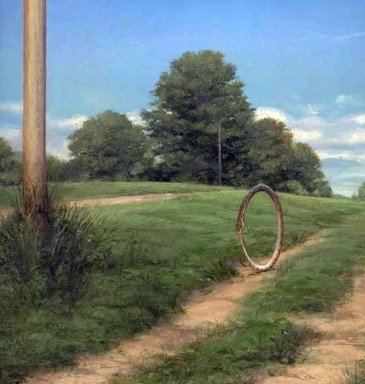
An artist's recreation of a hoop snake encounter. Photo: New Cryptozoology.
A hoop snake is a creature that's said to be able to bite down on its own tail and roll after its prey like a wheel. Hoop snakes have been seen in the USA, Australia and Canada.
Hoop Snake Description
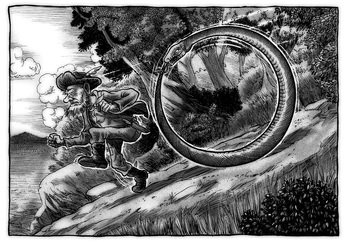
A hoop snake chases Paul Bunyan.
The hoop snake legend centers around a snake that can grab its tail with its mouth and roll after its prey like a wheel, a bit like the ouroboros from Greek mythology or the tsuchinoko from Japan.
Some versions of the story say that right before it strikes, the snake straightens out and stabs its target with its venomous tail, but you can escape by hiding behind a tree. The tree will take the hit and die from the poison instead.
Some claim that the hoop snake can roll at up to 60km per hour. Hoop snakes are said to grow up to 1.5m long and live for around 8 years. They come in a variety of colours ranging from light green to black.
Female hoop snakes are said to seek a new mate each year and lay up to 15 eggs in the spring.
The hoop snake has been part of the Western zeitgeist for a while, going all the way back to a letter from 1784. The author of the letter said that the hoop snake moves like a normal snake most of the time, but when it's chasing after something to eat, it curls up into a hoop and rolls towards its prey with its tail pointed forward, always ready to strike.
It was called the hoop snake after the hoops that children roll around as a toy.
Hoop Snake Sightings
Locals claim that hoop snakes can be found in the caves at Wilsons Prom in Victoria, Australia. They are also said to live near sister’s beach in Tasmania.
In the USA, hoop snakes have purportedly been sighted in the vicinity of the St. Croix River, which flows along the boundary between the states of Minnesota and Wisconsin. This area provides ample aquatic resources for the snake to navigate and conceal itself while pursuing its prey, which unfortunately includes humans.
Hoop snakes have also been reportedly observed farther east in Wake County, North Carolina. The reasons for the distribution of this species across such great distances remain unclear.
Theories about the Hoop Snake
A video about the legend of the Hoop Snake
There have been suggestions put forward by some that the hoop snake is a misrepresented depiction of the sidewinder of the American Southwest or of mud snakes, which have been observed lying in a loosely coiled circular shape on occasion.
It is speculated that the hoop snake may have arisen as a fanciful embellishment of real-life occurrences of snakes consuming their own tails, mistakenly mistaking them for prey.
Do you think the hoop snake is real? Let us know in the comments!
If you enjoyed this article you might also be interested in the tale of the Palmyra Wolves or Tahoe Tessie.

In 1923, several residents of Berkshire and Richford, Vermont reported seeing a creature resembling a griffin, with a 20 foot wingspan and a serpentine tail.
In the fall of 1951, English mountain climbers Eric Shipton and Dr. Michael Ward were exploring routes to climb Mount Everest from Nepal. While on this mission Shipton discovered some huge footprints in the snow, possibly belonging to the fabled Yeti.
A massive shark is caught on camera prowling near a research vessel off the Massachusetts coast, creating a buzz on social media. What is the link between NASA Zone F and this elusive megalodon?
The Salt Lake Herald featured a story in 1883 about three businessmen who stumbled upon a wild woman with three children who seemed to be half human and half bear.
The Native American Salish tribe recounts tales of a cryptid known as the Stick Indians, which remarkably mirror many reported sightings of Bigfoot.
In the winter of 1959, at least five eyewitnesses claimed to have seen a huge, bipedal creature resembling an octopus in the area around the Ohio River.
The Cornwall Owlman is a Mothman-like creature spotted repeatedly since the 1920’s in a churchyard in the UK.
In August 1817, the skipper of a trading ship entering Gloucester Harbour, Massachusetts, witnessed a baffling 60-foot long, leathery sea creature. This spectacle birthed the story of the Serpent of Gloucester.
In December 1964, a man named Robert Le Serrec witnessed a 75-80ft long creature underwater near Hook Island, Queensland.
Kasai Rex is a gigantic lizard creature that has been spotted several times in Democratic Republic of the Congo in Africa. Some believe it may be a surviving species of dinosaur.
Several people have reported seeing a huge, bigfoot-like creature with glowing orange eyes around Mansfield, Ohio.
In 1959, a group of three men from Ohio reported an encounter with a mysterious being near Charles Mill Lake. They described the creature as an immense humanoid devoid of arms, sporting luminous, green eyes, and webbed feet.
The Re’em is a creature mentioned nine times in the Bible, translated in the King James Version of the Bible as “unicorn”. Does this mean that Unicorns existed in Biblical times?
In 1942, a bigfoot-like creature was spotted in Cedar Bog, Ohio. This creature was blamed for the disappearance of a group of teenagers, and its legacy still haunt locals to this day.
An article in the Western Star from 1882 tells of a child being taken by a giant snake-like creature. The story was verified by the local doctor and a judge.
In September 2019, an extraordinary video emerged from China, showing footage of a massive and unusual sea creature swimming through the water.
Tsuchinoko are a snake-like cryptid from Japan, said to be about the size of a cat with scaly skin and viper-like fangs.
During the early 1900s, American lumberjacks told terrifying stories of encounters with the Slide-Rock Bolter - a whale like creature living in the mountains.
In Peru, there is a legend that if you commit incest, as a punishment, God will transform you into a monstrous llama with a human face, known as a Jarjacha.
The Nandi Bear is a ferocious cryptid spotted in the highlands of Kenya during the 19th and 20th centuries.
The Squonk is said to be the ugliest creature in the world. It is so ashamed of its appearance that it will hide from anyone who approaches and, if caught, it will dissolve into a puddle of tears.
The Shunka Warak’in is a hyena-like creature from Native American mythology that has been spotted in the Rocky Mountains. A museum in Montana claims to have one on display.
The Thunderbird Cryptid is a giant bird resembling a condor or vulture that has been seen all over the United States.
The Germantown Werewolf was a mysterious creature spotted in Defiance, Ohio, several times in 1972. It was a 6ft tall, bipedal wolf that was said to carry a plank of wood In its front paws.
The Black Bird of Chernobyl was said to be about the size of a small airplane, with glowing red eyes and a wingspan of over 20 feet.
Air rods, also known as "flying rods" or "sky fish," are a phenomenon that been captured on cameras and mobile devices worldwide.
A hoop snake is a creature that's said to be able to bite down on its own tail and roll after its prey like a wheel. Hoop snakes have been seen in the USA, Australia and Canada.
The Oklahoma octopus is said to dwell in several man-made freshwater lakes in Oklahoma such as Lake Thunderbird, Oologah Lake, and Lake Tenkiller, where it allegedly preys on unsuspecting swimmers.
The legend of Sheepsquatch is a folk tale from the Appalachian region of the United States. According to the legend, Sheepsquatch is a creature about the size of a bear with white fur and big horns.
Just like the infamous Silver Bridge Mothman sightings, witnesses claim seeing a strange, 7ft tall flying humanoid in the weeks before the collapse of the I-35W bridge in 2007.